

MedStar Mobile Healthcare’s mission is to be a high performance public utility model EMS system serving 14 cities in Fort Worth and North Texas, delivering patient-centered care, effective response and maintaining economic efficiency. is. But in the summer of 2018, it became increasingly difficult to accomplish that mission in a special section of MedStar’s service area during peak hours.
A new entertainment district has been developed near downtown Fort Worth. Called the West 7th Entertainment District, this 14-block area receives thousands of visitors Friday and Saturday nights from 10pm to 3am. The congestion of people and vehicles made it very difficult to provide the type of service that MedStar sought to provide. Further analysis of responses to the region revealed that many of the EMS responses were for minor medical problems and often did not require patient transport to hospital.
concept of response
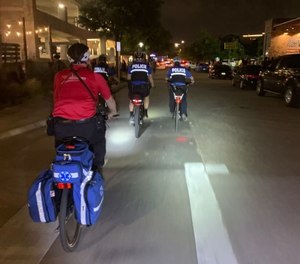
MedStar has a well-established Bicycle Emergency Response Team (BERT), which is frequently deployed at large special events. It was recently expanded to include the West 7th Entertainment District, which is bustling on Friday and Saturday nights. (Photo/Matt Zawadski)
In September 2018, Fort Worth Police Lieutenant Fred Long and Commander Cynthia O’Neill approached MedStar with a potential solution. The PD uses bicycle-riding police officers within the district and has found that the bicycle officers efficiently navigate vehicles and people to quickly get where they need to go. But they said that when people called his 911 or the officer wanted to evaluate someone for a medical or trauma incident, for a medical call he would let a MedStar ambulance into the area. I was dealing with the logistics.
MedStar had an established Bicycle Emergency Response Team (BERT) that was often deployed at large special events. As such, Commander O’Neill and Lt. Long felt it was worthwhile to invite the MedStar BERT team side by side. On a busy Friday and Saturday night with his PD’s bike rep in the West 7 District.
achievement of goals
The program has been a huge success on many levels. His BERT team on his MedStar deployed in the district His members are provided with police radios so officers can call the team directly if they encounter someone in need of medical evaluation or treatment. If a 911 call is received within his district, MedStar bicycle medics will be dispatched directly from his MedStar 911 center, and MedStar bicycle medics will be assisted by the police for logistics support and crowd control. Correspond.
Upon arrival at the scene, the BERT team will conduct a full evaluation to determine if the patient can be treated and released on site or if ambulance transport is required. Since the start of the partnership, 466 patients have been treated by his BERT team, of whom 282 (61%) have been treated and released in the field. This meant that ambulance resources were saved for other calls within MedStar’s service area rather than having to try to navigate congested districts.
Even if an ambulance is needed to transport a patient, the BERT team is already on site and the ambulance can often do so without lights or sirens. This accomplishes another MedStar goal, reducing the number of calls MedStar ambulances answer with lights and sirens.
medical care
MedStar’s BERT team members are all qualified EMTs or paramedics and carry a variety of medical equipment in three saddle bags attached to each bike. Medical equipment includes pulse oximeters, glucometers, oxygen, AEDs, suction, BVMs and other airway management equipment, trauma and splint supplies, medications approved for use by the BERT team (such as Tylenol, which is often requested by visitors). including over-the-counter (OTC) drugs. Benadryl and aspirin).
The bike will also be provided with a computer-assisted dispatch smartphone, patient care report tablet, and WiFi hotspot. This allows the BERT team to not only be seamlessly dispatched to medical calls by CAD, but also to create a complete chart for every patient. Treat and release. The technology also facilitates the transfer of patient care records from tablets to arriving emergency responders’ charts, making transfer of patient care efficient and effective.
The clinical cases managed by the BERT team run the gamut of what is seen on a typical ambulance shift, but reactions to seizures, falls, assaults, and alcohol intoxication are the most common. was the first EMS resource to rush to the scene of two gunshot wound victims simultaneously in two separate locations.
training
BERT team members undergo extensive training according to International Police Mountain Bike Association (IPMBA) standards, and BERT team coordinator Ross Gaston is a certified IPMBA instructor. Because some of the BERT challenges involve biking long distances, to be eligible for training and certification, BERT members must meet specific height and weight requirements and demonstrate basic physical fitness. You must pass the test. Training includes handling the bike, moving through crowds, traversing different types of terrain (especially curbs and stairs), and repairing the bike. Due to BERT’s assignments and the highly visible nature of the venue, public relations skills are also enhanced during training.
merit
MedStar has benefited greatly from the BERT program. In addition to operational benefits, there is tremendous value in public relations and employee relations. BERT’s team gives his members the unique opportunity to interact with the public in a way that ambulance crews cannot normally do. It is not uncommon for members of the BERT team to have extensive conversations with the public about his MedStar and even his EMS career.
During the deployment of BERT at a recent $10,000 fundraiser, a participant suffered a severe stroke. Within minutes, the BERT team was able to contact the patient, initiate treatment, call an ambulance, quickly transfer treatment to the arriving ambulance, and transport him to a local comprehensive stroke center. The patient made a full recovery and was featured in a local news article.
Joining the BERT team is considered a MedStar privilege and selection is relatively competitive. This gives employees something they strive to participate in. In addition, ambulance crews enjoy knowing the BERT team is there to reduce answering calls in difficult-to-access locations, and if answered, much of the patient’s care is well on arrival. is proceeding to
Read the following: Fourth 911 option. Austin’s 911 Mental Health Diversion Program Brings Adequate Resources to Mental Health Crises, Lowers Arrest Rates
About the author
Ross Gaston is the BERT Coordinator at MedStar. He has been with his EMS for his 18 years and since 2019 he is IPMBA certified and is also an IPMBA Instructor. For more information on his BERT program at MedStar, please contact Gaston at RGaston@medstar911.org.
Matt Zavadsky is MedStar’s Chief Transformation Officer and a member of MedStar’s BERT team.
