

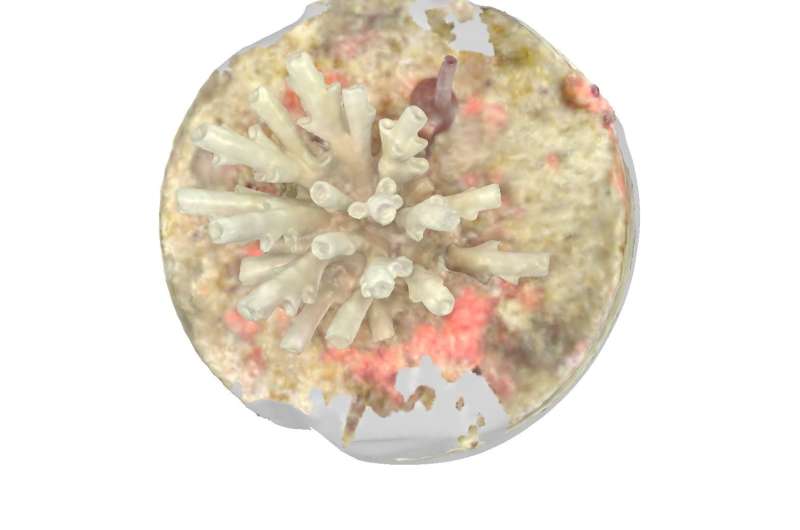
A 3D model of a baby coral skeleton scanned with Dr. Kate Quigley’s dental scanner.Credit: Dr. Kate Quigley
Inspired by a trip to the dentist, Dr. Kate Quigley presents a new method for monitoring coral size and growth that reduces survey time by 99%. The methodology and findings are Ecology and Evolutionary Methods.
Dr. Kate Quigley, a senior research scientist at the Minderoo Foundation who has worked at the Australian Institute of Marine Science and James Cook University, has developed a new non-destructive method to scan corals quickly and safely. and long surveying techniques.
Inspired by a visit to the dentist, Dr. Quigley noted the similarities between corals and our teeth. Both are calcium based and require a measuring tool that can withstand wet surfaces. “I went to the dentist one day and this new scanning his machine was introduced. Considering that corals and teeth actually share many similar characteristics, it’s possible to scan very small corals.” I quickly realized it was applicable, and the rest is history.”
Coral reefs are one of the most productive ecosystems on earth, providing essential nutrition and protection services to people around the world. These important ecosystems have suffered severe decline in recent decades, prompting a surge in research into their basic biology and recovery. By understanding key life stages of larval corals, scientists can predict ecosystem change, the impact of disturbances, and potential for recovery.
Reconstructing 3D models of corals reveals insights into coral health and responses to pressures such as warming and acidification. There are several ways to build and evaluate these 3D models, but their effectiveness diminishes when building small scale measurements.
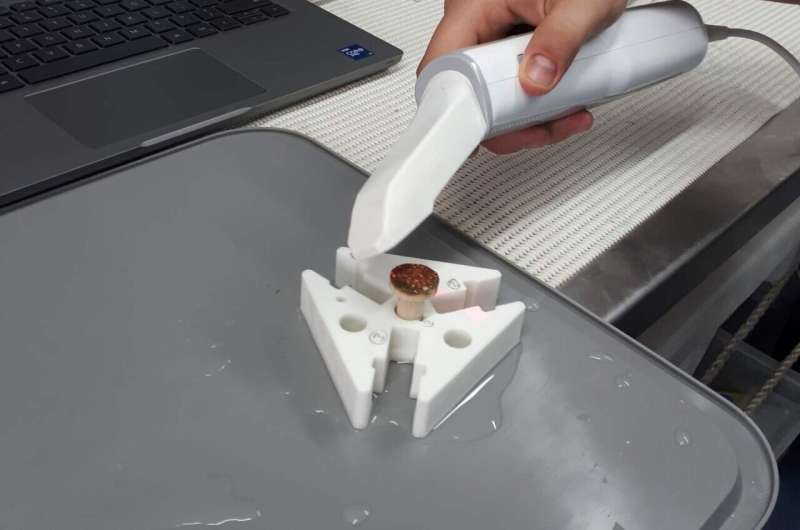
Dr. Kate Quigley used dental scanning equipment to measure coral babies directly from the boat.Credit: Dr. Kate Quigley
Dr. Quigley said:
“During my PhD, it took half a day to make one scan. I was interested in scanning hundreds of corals at once.
“This new method will enable scientists, for the first time, to measure thousands of small corals quickly and accurately without adversely affecting coral health. This will enable large-scale monitoring of ocean health. and have the potential to expand coral reefs.”
To evaluate the effectiveness of these dental scanners, namely the ITero Element 5D Flex, Dr. Quigley measured larval corals on the Australian Institute of Marine Science’s National Ocean Simulator. Great he barrier he relief corals were temporarily removed from the indoor tank and surface area and volume recorded before being returned to the tank.
On average, it took less than 3 minutes to scan an individual coral and build a model, compared to over 4 hours with previous methods. He reduced the time required to perform such measurements by 99%. Dr. Quigley recorded similarly fast and accurate performance when measuring and comparing models of dead skeleton and living coral tissue. No more sacrificing live animals for measurements.
While this is a major step forward in reducing the time it takes to monitor and study small marine animals, 3D scans still require manual processing, slowing analysis. Dr. Quigley hopes that the next step in this research will be to try and create an automated analysis pipeline from scan to measurement, potentially using AI.
Currently, this technology can only be used for underwater measurements. The hardware is not waterproof as the scanner relies on confocal laser technology.
“The scanner could also be made completely waterproof. However, it is unclear whether the laser technology would work perfectly underwater. I’ve grown lab-grown corals once.
Coral parents selected to give birth to heat-tolerant babies
How to quickly and accurately create micron-level 3D models of corals in vivo using a dental scanner Ecology and Evolutionary Methods (2022). DOI: 10.1111/2041-210X.13959
Courtesy of the British Ecological Society
Quote: Ecologists study young corals using the latest dental scanning technology (August 31, 2022) on August 31, 2022 at https://phys.org/news/2022-08-ecologists Taken from -latest-dental-scanning-technology.html
This document is subject to copyright. No part may be reproduced without written permission, except in fair trade for personal research or research purposes. Content is provided for informational purposes only.
