

Despite being a country of 1.4 billion people, the average Indian remains a dumb, bespectacled engineer who wins spelling bees and speaks with a strange accent in much of the West.
India celebrates its 75th anniversary of independence from British colonial rule on August 15th. Indian talent and culture span the globe, from yoga and spirituality to CEOs of multinational companies such as Google and Twitter.
In North America and Europe, however, simplistic depictions of the country still dominate many minds.
Here are some common misconceptions people have about India.
Indians are not synonymous with Hindus
Starting with the basics, India is a diverse country with several major religions including but not limited to Hinduism, Islam, Christianity, Buddhism, Sikhism and Jainism. According to the 2011 Indian Census, approximately 2.9 million people identify as atheists.
In India, language and culture can change every 50-100 km (31-62 miles), and a simple hello goes from namaste to sat siakar to as-salamu alaykum in 2 hours. drive. Each state has its own primary language and hundreds of dialects.
Beyond the “Indian Accent”
In a country as diverse as this, it’s impossible to have one ‘Indian accent’. Unless you’re talking about Chef Manish his Mehrotra Chef’s iconic establishment on the coveted ‘Asia’s 50 Best Restaurants’ list.
For starters, Mehrotra’s ‘Indian Accent’ restaurant has branches in New York, London and New Delhi, and as the chef himself explained to the South China Morning Post in 2018, ‘It’s not Indian Indian food, it’s global food. Advertises “Indian cuisine”.
According to the 2011 census, English is the second most widely spoken language in India and is often used as a medium of communication between Bengali speakers in eastern West Bengal and Malayalam speakers in southern Kerala. will be used.

Apu Nahasapeemapetilon — seen here plastered on a window — was a popular character on “The Simpsons.”
So while many Indians may not have “native speaker” language skills, you can imagine their fear when confronted with the “Apu accent” of “The Simpsons.” US actor Hank Azaria, who has voiced Apoo since the show began in 1989, has apologized “to all Indians” and announced that he will be replaced in 2021 amid criticism of racial stereotypes. resigned from the role of
Not all Indians are vegetarian
Although the West sees India as a leader in the vegetarian movement, the numbers may be higher than in other parts of the world, but only about 30% of the Indian population are aware of this dietary preference. increase.
According to the National Family Health Survey 2019-2020, nearly 70% of Indians consume some form of meat and eggs, and about 7% eat beef. However, the last figure may be underreported. This is because of the cultural and political ramifications of allowing this in a very harsh environment. In recent years, beef consumption has been cracked down in Hindu-majority countries, where cows are considered sacred.
Poverty porn won’t give you extra points
While Danny Boyle’s “Slumdog Millionaire” took India to the Oscars, it came at a high price. Poverty is a daily reality for the majority of Indians, with almost 60% of the country’s population living on less than $3.10 a day, according to the World Bank.
The voyeuristic portrayal of their lives on the big screen can be seen as a glorification of poverty for Western audiences. Through a sepia lens it shows crowded streets, open sewers and malnourished children.
Adds a ‘white savior complex’ to ‘help’ poor Indians overcome their doom, like ‘Million Dollar Arm’ starring Jon Hamm and ‘City of Joy’ starring Patrick Swayze Doing so will only take away the autonomy of the local people.
Bollywood is not the only film industry in India
‘Bollywood’ or the Hindi film industry is often considered the sole representative of Indian cinema. Extravagant weddings, flashy dance sequences and dizzying colors reinforce the cliché where grandiose sets, musical numbers and grand romance gestures encapsulate the essence of India.

Mural of legendary Indian filmmaker Satyajit Ray in Kolkata, West Bengal
However, India produces films in several languages and some of its greatest gems are made in regional languages. From Satyajit Ray’s 1955 Bengali film ‘Pather Panchali’ to this year’s Telugu epic drama ‘RRR’ which raked in his $90 million in its first week of release, the Indian cinema universe is vast. and is clearly growing.
India is not your country of self-discovery
Hermann Hesse’s iconic 1922 novel “Siddhartha” was for many Europeans an early introduction to the “Indian spiritual brand” despite years of colonial invasion across the subcontinent. was.
Over time, this fascination has burgeoned into an international trend, with thousands of expats visiting holy sites such as Rishikesh and Haridwar to experience yoga and the alternative Ayurvedic system of medicine.
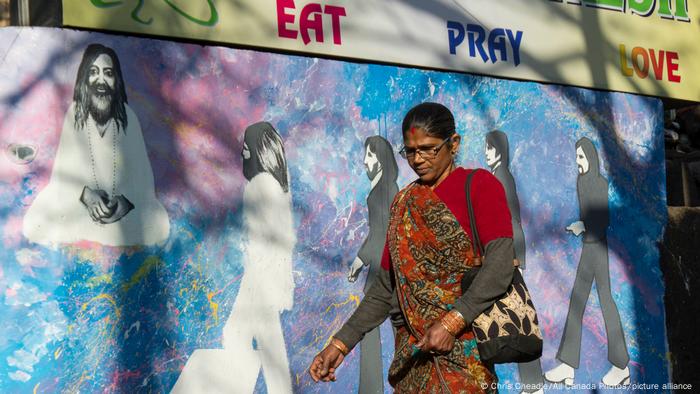
A woman walks the streets of Rishikesh, a sacred place visited by the Beatles
But while some may believe the Beatles and Julia Roberts movie Eat Play Love will achieve nirvana on the streets of India, many residents believe that the overtly I avoid images that are mysterious and superstitious.
Indian food ≠ Diarrhea
Finally, India’s diversity is best represented in its food, which is limited to just curries. Beyond “chicken tikka masala” and “naan bread” (which, by the way, translates to “bread bread”), the country has a gastronomic map that can compete with entire continents.
From Kashmir’s multi-course wazwan, Bihar’s ritti choka and Goa’s pork vindaloo, to Manipur’s kanshoi, Rajasthan’s laal maas and Karnataka’s pandi curry, it would take a lot of paper to list Indian cuisine.

A man holding a plate of wazwan, a traditional Kashmiri kaiseki meal
The use of spices isn’t for every palate, but the Western portrayal of Indian food as blindingly spicy or “just the same” is not only problematic, it’s downright wrong. I’m here.
In our increasingly connected world, many of these stereotypes are being denounced on the internet for what they really are: obsolete. On the other hand, the global community has also shown a growing appetite for learning as people spend more time improving their cross-cultural knowledge and abilities.
.
