

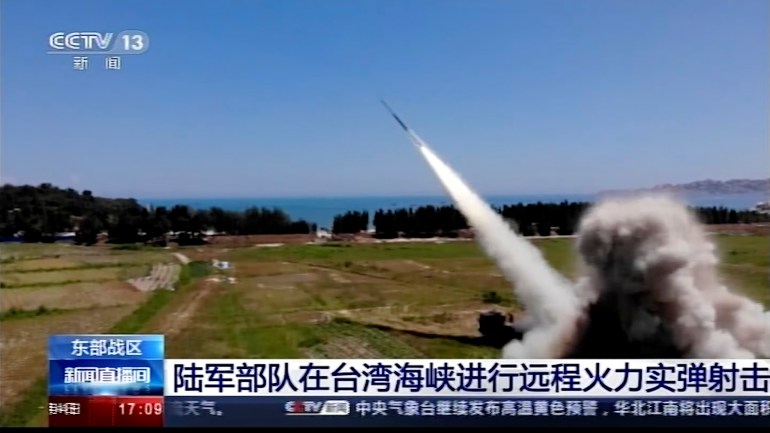
Taipei, Taiwan – Over the past two weeks, Taiwanese mostly shrugged when the Chinese military conducted unprecedented live-fire exercises around Taiwan.
On August 6, at the height of the exercise, revelers danced the night away from Dongyin, a Taiwan-controlled island in the Matsu archipelago just 50 kilometers (30 miles) from China’s Fujian province.
Lii Wen, head of Taiwan’s ruling Democratic Progressive Party (DPP) Matsu branch, joked that the “EDM bubble bath party is on the rise” during the “fourth Taiwan Strait Crisis” .
Rising tensions may be hard to ignore for many multinationals that are vital to the health of Taiwan’s economy.
It remains to be seen whether China’s increased military activity will adversely affect foreign investment in Taiwan, but some foreign companies operating on the island have already begun exploring the possibility of relocating elsewhere.
Several foreign business executives, who spoke to Al Jazeera on condition of anonymity, said recent tensions over the democratically-controlled island Beijing claims to be its territory have prompted them to consider relocating. said.
An executive at an international consumer goods company based in Taiwan for more than a decade said the scale of China’s live-fire training served as a “wake-up call.”
“Earlier when China threatened Taiwan, I was negative because it was a verbal threat. This time it looks more genuine,” he told Al Jazeera.
The company’s main investor felt the same way, and asked him to explore the possibility of establishing both a manufacturing facility and an office in Thailand that would serve as the company’s regional headquarters. He said he was considering moving to
Investors “don’t want to wait for things to get any worse,” he said, posing “serious risks to the company’s personnel and supply chain.”
An executive at a Taiwan-based Fortune 500 company said it was considering moving to Singapore because it lacked confidence that the island could adequately deal with a growing military threat from China.
“The biggest concern for me is security, which is tied to the theme of unresponsive business as usual, a rigid government and military,” he told Al Jazeera. If not, I don’t know what would have happened.”
The executive added: They don’t realize how hot the water is. “
Their concerns seem to be widely shared among the island’s expat business community.
In a survey released Friday by Taiwan’s American Chamber of Commerce, 43% of respondents said they were modifying or planning to modify their contingency plans to deal with a serious crisis on the island.
Of the 126 participants in the survey, conducted August 8-17, 77% reported that recent military activity in the Taiwan Strait had not significantly affected their business, and 17% said it was disrupted. said to have experienced
Overall, survey respondents’ average level of concern about significant actions against Taiwan occurring over the next 24 months was 2.8 on a scale of 1 to 5.
“China’s recent military exercises are a reminder to multinationals that investing in Taiwan, holding shares in publicly traded Taiwanese companies, or having employees in the country are not exempt from the risk of lockdown or war. “I’m a based attorney and political risk analyst,” he told Al Jazeera.
Regular Chinese military exercises near Taiwan could seriously affect commercial air and sea routes given the island’s position along one of the world’s busiest sea routes. In the first seven months of this year, about 50% of the world’s container ships and her 88% of the largest container ships have passed through the Taiwan Strait, according to Bloomberg.
After suspending exercises sparked by House Speaker Nancy Pelosi’s Aug. 2-3 visit to Taiwan, Beijing resumed exercises this week following a surprise visit to the island by a new delegation of U.S. lawmakers. resumed.
“It shows that exercises that could disrupt shipping and private air travel are likely to occur on a regular basis,” Feingold said. “This will not only disrupt the shipment of goods out of Taiwan, but could disrupt inbound shipments of raw materials, food and energy.”
border restrictions
Exacerbating the heightened risks Taiwan faces from Chinese aggression is self-isolation stemming from Taiwan’s reluctance to ease some of the world’s toughest pandemic-related border restrictions. is. Taiwan is maintaining her four-day mandatory quarantine for all arrivals and has yet to resume normal issuance of business and tourist visas.
Critics say border controls are unique outside of China and questionable for public health. Since January 1, 99.5% of COVID-19 cases have been mild or asymptomatic, according to Taiwan’s health authorities. Of her 23.5 million inhabitants on the island, 86.2% received her two doses of vaccine and 71.8% boosted.
Nonetheless, Taiwan is struggling to transition from its once virtually zero Covid strategy, which was so popular with voters, to its new normal. The government officially abolished the policy in April, but officials are widely seen to fear the political repercussions of a surge in cases related to overseas travel.
“Unfortunately, the Taiwanese government has fenced itself in by maintaining these controls longer than most countries in Asia, and the window to lift these controls ahead of the November 26 local elections is rapidly approaching. It’s closed to us,” Feingold said.
Taiwan continues to host political figures, with a US congressional delegation led by Sen. announced the start of negotiations for an investment treaty.
Business leaders, however, argue that the occasional high-profile trip cannot make up for the loss of two and a half years of regular business interaction.
“The business relationship is very fragile,” Frederick Rocafort, an attorney at Seattle-based law firm Harris Bricken, which serves Taiwanese manufacturing clients, told Al Jazeera.
“If you don’t have the ability to network and maintain existing clients, you can find someone else in a year or two.”
Andrew Wyregala, president of the American Chamber of Commerce in Taiwan, said the island should welcome foreign business and investment with open arms given its long-term strategic goal of reducing economic dependence on China. .

China, including Hong Kong, accounted for more than 40% of Taiwan’s exports last year.
“If there is ever a place and time to defy the old adage ‘keep your friends close and your enemies close,’ it will be Taiwan in August 2022,” Willegala told Al Jazeera. “Circulating goods, talent and money with friendly partners is the best way to strengthen Taiwan, and we still need to move people.”
Netherlands-based PJ Broodbakker, vice president of sales and marketing at Dutch company Haiku Tech, a manufacturer of multi-layer ceramic device manufacturing equipment, said his company is looking to increase the number of suppliers in Taiwan. Told. However, he has not visited Taiwan in over three years, citing mandatory quarantine as the main reason.
Although the current quarantine is only four days, “it’s still very inefficient, especially when the trip involves several team members,” Broodbakker told Al Jazeera.
“For us, we are always keen to work with Asian suppliers for technology projects and Taiwan seems like the most logical place to go. We are increasingly looking elsewhere because we don’t see a solution,” he said.
.
